Opens in a new window
Slate Digital Rotary SD-147 - Download Rotary SD-147 - Download


Buy Online
In Stock
This product is delivered by download. Once your payment has been approved your software license will be sent to you via email. The download link for your purchase will be included with your license.
Software Is Not ReturnableRelated Products
Description
The Cabinet Masterfully Modeled
It worked. Then it kept working on instruments it was never designed for. By the time pop music caught up, the rotating speaker had been used on jazz organ, gospel piano, psychedelic guitar, soul horns, prog rock vocals, and a Beatle pretending to be the Dalai Lama.
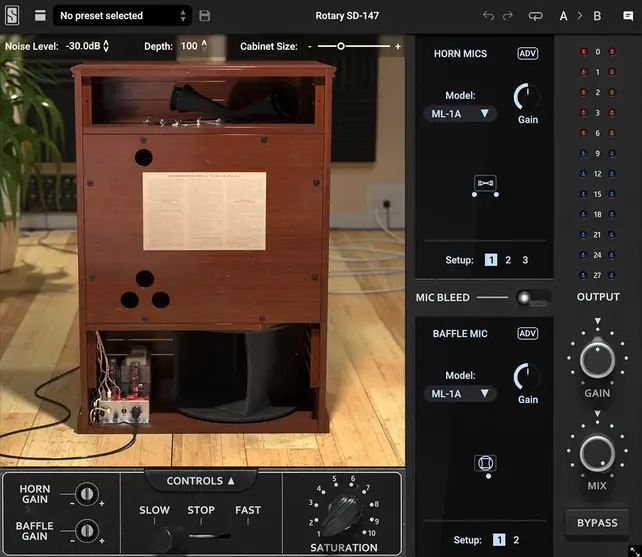
Rotary SD-147 puts that cabinet on a track in your DAW. Mono or stereo. Mac or Windows. No 150-pound box. No cracked capacitors. No relay clicks.
Two rotors, modeled top to bottom
A rotating horn for the mids and highs. A rotating drum for the lows. Independent gain on each so you can find the balance you want: bright and singing, warm and round, or something the original cabinet was never quite capable of. Acceleration and deceleration are modeled per rotor, matching the real cabinet. The lighter horn ramps up before the heavier drum catches up.
Three speeds. Played, not just set.
Slow (Chorale). Stop. Fast (Tremolo). The toggle is the heart of the instrument, and it was always meant to be played live. Map it to a MIDI controller or a keyswitch and you'll trigger the spin-up and spin-down in real time, the way the cabinet was used on stage. Or automate it in your DAW so the transitions land on the beat. The Accel and Decel knobs decide how fast the rotors get there: clockwise for snap, backed off for long woozy ramps. Tempo Sync locks the rotation to your project tempo for musical time. (And if you want to decide where the rotors stop, Brake to Position handles that. More on it in the next block.)
Beyond physics
Mechanical noise from "real and noisy" to "completely silent." Mic bleed on (the natural recording behavior) or off (impossible on the original device, since each rotor was always picking up sound from the other). Brake to Position stops the horn and drum at any angle you specify, fully automatable. Pin the sound to an exact spot in the stereo field on a precise beat. The original cabinet could do none of this. Slate Digital built it because you should be able to.
It worked. Then it kept working on instruments it was never designed for. By the time pop music caught up, the rotating speaker had been used on jazz organ, gospel piano, psychedelic guitar, soul horns, prog rock vocals, and a Beatle pretending to be the Dalai Lama.
Rotary SD-147 puts that cabinet on a track in your DAW. Mono or stereo. Mac or Windows. No 150-pound box. No cracked capacitors. No relay clicks.
Two rotors, modeled top to bottom
A rotating horn for the mids and highs. A rotating drum for the lows. Independent gain on each so you can find the balance you want: bright and singing, warm and round, or something the original cabinet was never quite capable of. Acceleration and deceleration are modeled per rotor, matching the real cabinet. The lighter horn ramps up before the heavier drum catches up.
Three speeds. Played, not just set.
Slow (Chorale). Stop. Fast (Tremolo). The toggle is the heart of the instrument, and it was always meant to be played live. Map it to a MIDI controller or a keyswitch and you'll trigger the spin-up and spin-down in real time, the way the cabinet was used on stage. Or automate it in your DAW so the transitions land on the beat. The Accel and Decel knobs decide how fast the rotors get there: clockwise for snap, backed off for long woozy ramps. Tempo Sync locks the rotation to your project tempo for musical time. (And if you want to decide where the rotors stop, Brake to Position handles that. More on it in the next block.)
Beyond physics
Mechanical noise from "real and noisy" to "completely silent." Mic bleed on (the natural recording behavior) or off (impossible on the original device, since each rotor was always picking up sound from the other). Brake to Position stops the horn and drum at any angle you specify, fully automatable. Pin the sound to an exact spot in the stereo field on a precise beat. The original cabinet could do none of this. Slate Digital built it because you should be able to.
Q & A
There are currently no questions for this product.
Reviews
There are currently no reviews for this product. Be the first to write one!
Reserve in Store

| Product | SKU | Qty |
|---|---|---|
| Rotary SD-147 - Download | 843833 |