Gear Hunter
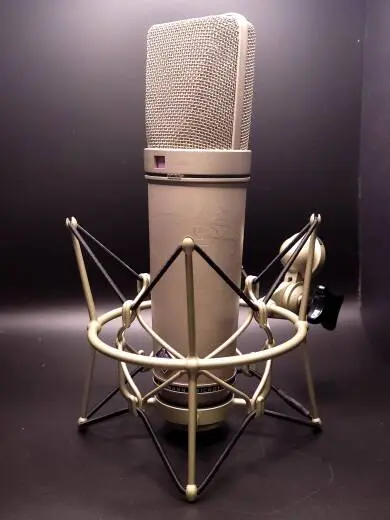
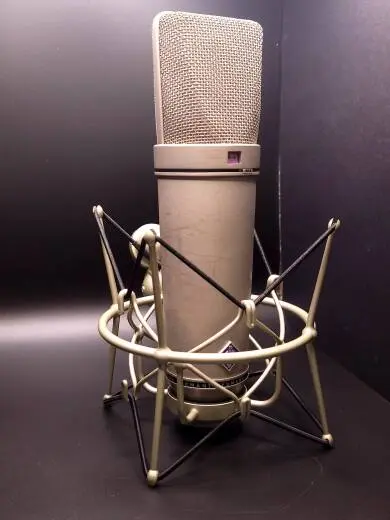
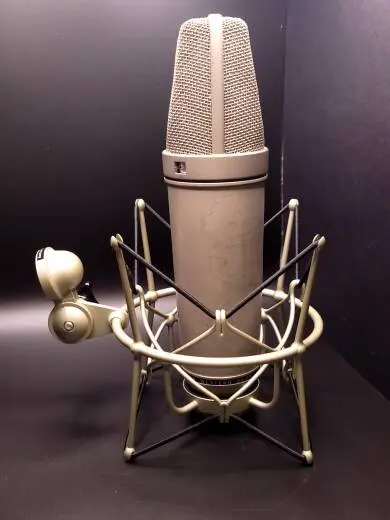
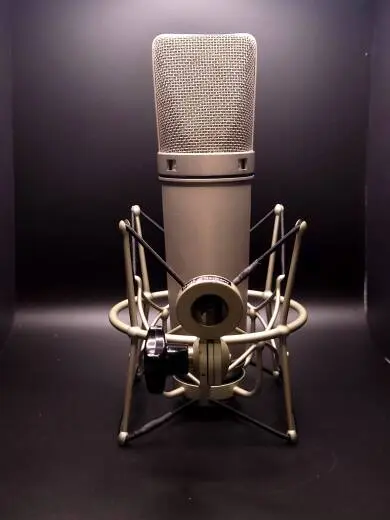
Neumann - U 87 AI SET
Sale Price: $5250
Buy From Store
Quantity Available: 1
Condition: Used Good Condition
Customer responsible for any shipping charges.
This product may not come in original packaging.
Description
Accessories Included: Shockmount included
*** Does not come with original box***
The Neumann U 87 Ai is arguably the world's best-known and most widely used studio microphone. Its smooth, refined sound is as iconic as its elegant design. The U 87 Ai is the go-to microphone for speech and vocals. Its three polar patterns, along with attenuator and low-cut options, make it adaptable to a wide range of applications.
Balanced frequency response in three polar diagrams
* Very low self-noise
* His classic
The U 87 Ai is the epitome of the large-diaphragm condenser microphone. Its tapered body and iconic grille have become ingrained in the collective imagination: this is what a studio microphone looks like. The same is true for its sound quality: the U 87 Ai represents studio quality; it has become the absolute benchmark for microphones.
What sets the U 87 Ai apart is its unique blend of linearity and character. While its on-axis frequency response is remarkably flat, it exudes an undeniable charm. Its sound is simply perfect! This is what makes the U 87 Ai both versatile and instantly recognizable.
Applications
The U 87 Ai condenser microphone is a large-diaphragm microphone with three polar patterns and a unique frequency and transient response. It is ideally suited for most general studio applications, as well as for broadcast, film, and television. The U 87 Ai is used as a main microphone for orchestral recordings, as a fill microphone for solo instruments, and frequently as a vocal microphone for all types of music and speech.
Acoustic characteristics
The U 87 Ai microphone, adorned with the Neumann logo, is front-facing. Its frequency response, with a cardioid and bidirectional (figure-eight) polar pattern, is very linear at frontal incidence, even at high frequencies. It can be used very close to the sound source without the sound becoming harsh. A high-pass filter significantly attenuates interference in the low and infrasound frequencies.
Polar Models
The dual-diaphragm capsule is mounted on an elastic suspension and protected by a large grille. A switch located beneath the grille allows selection of three polar patterns: omnidirectional, cardioid, and figure-eight. A window above this switch displays the symbol for the selected pattern.
Electrical characteristics
The letter A in the name indicates a more recent generation, compared to the U 87 i microphones which were manufactured from 1967 to 1986. The changes only concern the electronic components of the microphone; the capsule has remained unchanged.
The current circuitry increases the operating margin of the U 87 Ai by supplying the capsule bias voltages through a reduced resistance. This results in a 10 dB increase in sensitivity for the same sound pressure levels and a 3 dB improvement in signal-to-noise ratio.
Filter and attenuate
A switch located on the rear reduces the sensitivity by 10 dB. When this switch is activated, the microphone accepts sound pressure levels up to 127 dB (equivalent to a sound pressure of 45 Pa) without distortion.
An additional switch on the back allows you to change the microphone's cutoff frequency. This reduces low-frequency interference directly at the microphone amplifier's input.
This setting also compensates for the inevitable bass boost that occurs with all pressure gradient transducers when used at close range (proximity effect).
The cardioid characteristic maintains a regular frequency response at a distance of 30 to 40 cm, the figure-eight characteristic even at a distance of 15 to 20 cm.
Features
Variable wide diaphragm microphone
Pressure gradient transducer with double-membrane capsule
* The classic studio microphone
* Three directional characteristics: omnidirectional, cardioid, bidirectional (figure 8)
* Switchable low-frequency attenuation
* Switchable 10 dB pre-attenuation
Ideal as a main and backup microphone in a wide variety of recording situations.
Specifications
Acoustic operating principle: Pressure gradient transducer
Directional diagram: omnidirectional, cardioid, figure-eight
Frequency range: 20 Hz - 20 kHz
Sensitivity at 1 kHz in 1 kohm: 20/28/22 mV/Pa1)
Nominal impedance: 200 ohms
Nominal load impedance: 1 kΩ
Equivalent noise level (CCIR): 26/23/25 dB1)
Equivalent noise level (A-weighted): 15/12/14 dB-A1)
Signal-to-noise ratio (CCIR) (rel. 94 dB SPL): 68/71/69 dB1)
Signal-to-noise ratio (A-weighted) (rel. 94 dB SPL): 79/82/80 dB1)
Maximum SPL for THD 0.5%3): 117 dB (cardioid)
Maximum sound pressure level (SPL max. for a total harmonic distortion of 0.5% with pre-attenuation): 127 dB
Maximum output voltage: 390 mV
Supply voltage (P48, IEC 61938): 48 V 4 V
Current consumption (P48, IEC 61938): 0.8 mA
Compatible connectors: XLR3F
Weight: 500 g
Diameter: 56 mm
Length: 200 mm
Neumann - U 87 AI SET