
Offset Guitars: What’s With All The Switches?
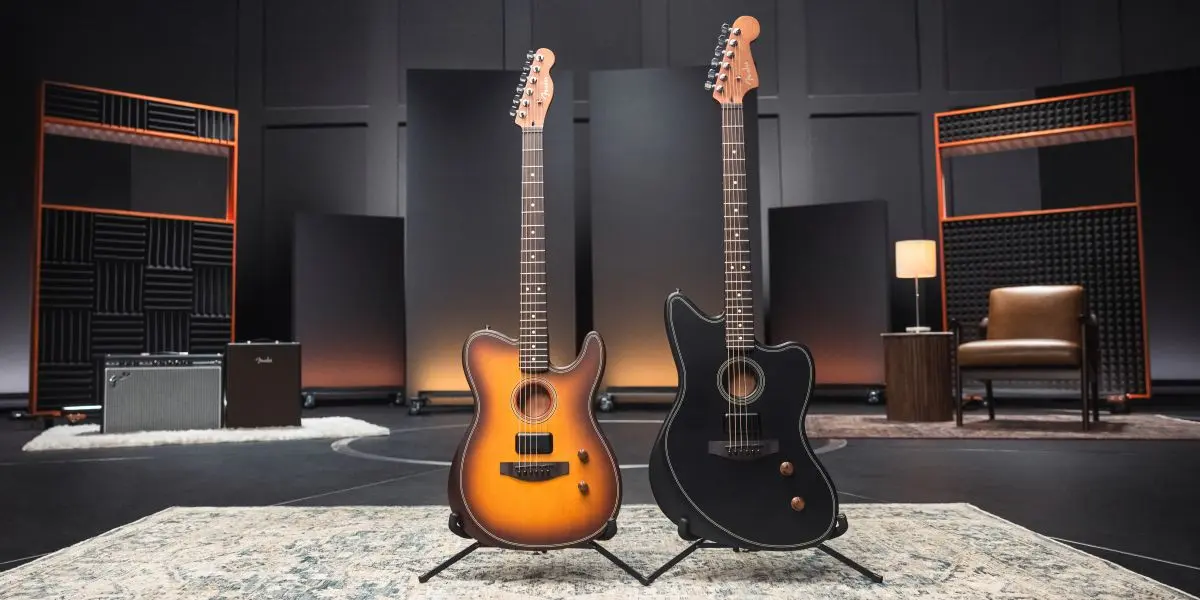
Nearly seven decades after their introduction, so-called “offset” guitars still carry an aura of alternative culture and the non-mainstream.
The Jazzmaster, Jaguar, Mustang, and their derivatives and descendants have traced a musical line from surf to punk, post-punk, indie, alternative, and beyond, with detours into jazz and R&B (Joe Pass and Jimi Hendrix were notable early dabblers), and they’re more widely available and popular in the 21st century than ever before. But they remain a bit misunderstood.
What Is an Offset Guitar?
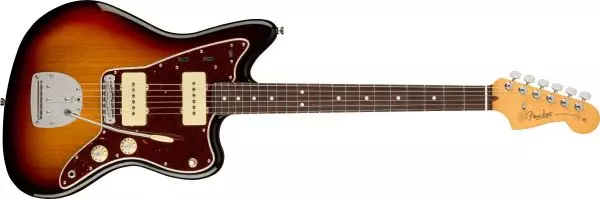
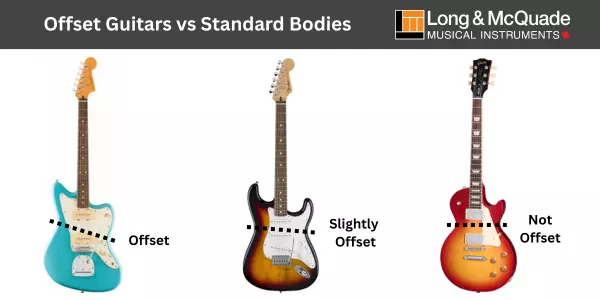
They’re called “offsets” because their waist is diagonal. This is the part where the body narrows to accommodate the knee (when played seated) and belly. If you were to draw a line from the thinnest part of the guitar, an offset guitar would have a slanted line, hence the name.
On guitars like the Stratocaster, Telecaster, Les Paul, and SG, the waist forms a straight line perpendicular to the neck. For the Jazzmaster, Jaguar, or Mustang, this line is shifted, or “offset,” from the center.
Why Fender Created Offset Guitars
In Leo Fender’s original 1958 patent, the offset body was designed to make for a more comfortable playing experience when seated. This was important because Fender perceived that jazz guitarists tended to play sitting down, and jazz guitarists were one market that his company’s futuristic solid-body instruments had yet to attract.
Hence, the Jazzmaster, introduced in 1958 as the company’s top-of-the-line instrument, was full of innovative features to complement its radical design. The Jazzmaster was followed by a bass sibling, the Jazz Bass, in 1960.
The idea made sense. The offset shape moves the area around the 12th fret, which bebop players often use, out of your lap and into a more comfortable spot for your left hand. However, this also puts the first position, where “cowboy chords” are played, a little farther away.
The new design also swapped out the Strat’s springs, claw, and fulcrum for a vibrato system inspired by the single-spring Bigsby unit, which was common on many hollow-body guitars used by jazz and western swing players.
The Rise of Fender Offset Guitars
From Jazz Clubs to Surf Rock
Jazz musicians were (and remain) a conservative lot, so the Jazzmaster and “J” Bass never really caught on with their intended audience, despite a few early adopters.
The Jazzmaster did, however, catch on with the burgeoning surf movement, particularly in the hands of the Ventures, whose blockbuster hit “Walk Don’t Run” brought the sound of the Jazzmaster to an international audience.
Enter the Jaguar
Recognizing a new market, Fender slightly revised the Jazzmaster into the Jaguar, a new top-of-the-line model that retained the innovative features of the Jazzmaster but with a shorter 24” neck scale. The intention of the Jaguar was to facilitate high-speed playing, hence the appropriate name.
The shorter neck also fixed the Jazzmaster’s issues with the first position. The Jaguar’s many switches and chrome plates made it look even more futuristic than the Jazzmaster, and it was priced to match accordingly.
Other Classic Offset Guitar Models
The Jaguar was closely followed by a range of other offset instruments, including:
- the Mustang (a smaller-bodied student model),
- a revised Duo-Sonic (the original Duo had been a straight-waist student model based on the Stratocaster),
- the Electric XII,
- the Bass VI, and
- the Gibson Firebird (with the offset going in the other direction)
Most of these followed the Jaguar in liberally peppering the guitar body with switches.
What Do All the Switches on Offset Guitars Do?
The main idea behind the Jazzmaster and Jaguar’s switching systems is surprisingly modern. If these guitars were invented today, people would probably call these settings “presets.”
Below, we explain what each switch does and how it differs across models. You can also watch a short video I made for my niece explaining the switching on her Classic Vibe Jazzmaster:
Classic Vibe Jazzmaster Switching Demo.
The Jazzmaster Rhythm Circuit Explained
On the upper (bass side) bout of a Jazzmaster and Jaguar, you will find a switch and two thumbwheels. When this switch points down toward the treble strings, the controls function much like those on any other electric guitar, with pickup switching and master volume and tone controls.
But if you pop that switch upwards, toward the player, the normal controls on the treble side are disabled. The bridge pickup shuts off. The neck pickup alone is now routed through a different, mellower capacitor, to produce a sound that was intended to lend itself to a jazz rhythm tone.
You are now on the “rhythm circuit.” The thumbwheels are independent volume and tone. You can now easily switch between a tailored “lead” tone (circuit switch down) and “rhythm” tone (circuit switch up) with the click of one switch. Presets, 1950s style!
Jaguar Switching System Explained
The Jaguar drops the Les Paul-style three-way toggle switch and adds a bank of switches on the treble side.
The two closest to the neck are on-off switches for the two pickups. Pull either switch towards you (i.e. toward the bass side) to engage a pickup.
What Is the Jaguar “Strangle” Switch?
The third switch, the one closest to the bridge, is the bass cut or “strangle” switch. Its effect on the tone is the opposite of the “rhythm circuit.” It gives a jangly surf tone that defines the Jaguar.
Carl Wilson of the Beach Boys played his searing Chuck Berry-meets-the Ventures surf leads with all of his Jag’s switches toward him, in the on position.
Bass VI Switching Explained
The Bass VI has a switching system like the Jaguar, but without the “rhythm” circuit. It keeps the on-off switches and the “strangle” switch. The Bass VI also adds a third pickup, like a Strat, so there are four switches on the treble side instead of three.
Mustang and Duo-Sonic Switching Explained
The Mustang, Duo-Sonic II, and prototype versions of the Electric XII use a different system altogether.
On these instruments, as originally designed, there are three-way switches on the bass side of either pickup. The center position is “off.” When you move the switch outward from the center, the pickup is on.
If both switches are pointed in the same direction (i.e., both towards the neck or both towards the bridge), the pickups are both on, in parallel and in phase.
Having the two switches pointing in opposite directions puts the two pickups out of phase, producing a distinctive, thin “quack.”
Offset Guitars in Punk, Indie, and Alternative Music
The End of Surf Era
After the surf era ended in the mid-1960s, thousands of offset guitars ended up in pawn shops. That’s where the first punk bands found them, and later, younger musicians who started indie, shoegaze, and grunge music in the ’80s and ’90s also picked them up. These bands helped cement the link between offset guitars and alternative culture.
Kurt Cobain and the Offset Guitar Revival
Famously, just before he died, Kurt Cobain was asked about a signature guitar. He cut up photos of a Jag and a Mustang, taped them together, and created the Jagstang.
Since the ’80s, countless teens have probably had the same experience I did: looking at the cover of Spacemen 3’s The Perfect Prescription, seeing Pete “Sonic Boom” Kember playing his Jag, and wondering:
“What do all those switches do?”
Best Offset Guitars to Try Today
Affordable Offset Guitars
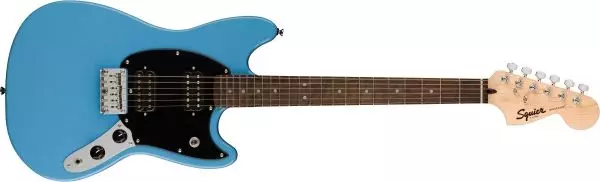
Squier Sonic Mustang
The Squier Sonic Mustang offers the iconic Fender style and inspiring tone for beginner players. The Mustang sports a clim “C”-shaped neck profile, short 24” scale length, 6-saddle hardtail bridge, and a thin, lightweight body for optimal playing comfort, great for smaller players.
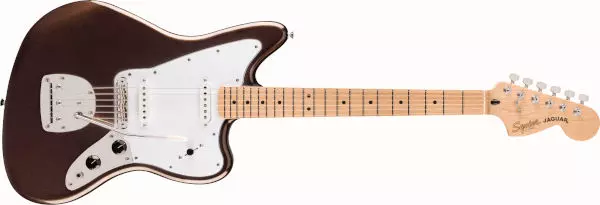
Squier Affinity Jaguar
The Squier Affinity Series Jaguar delivers legendary design for today's aspiring guitar hero. This model features a thin and lightweight body, a slim and comfortable "C"-shaped neck with short 24" scale length, a vintage-style tremolo and floating bridge and sealed die-cast tuning machines with split shafts for accurate tuning and easy restringing. The Jaguar is loaded with two Squier single-coil pickups with 3-way switching.
Shop the Squier Affinity Jaguar
Mid-Range Offset Guitars
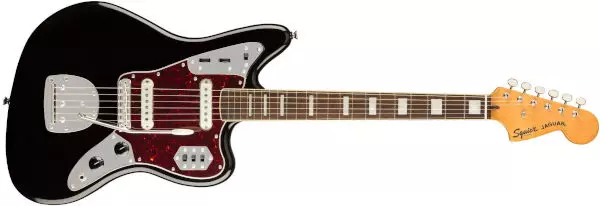
Squier Classic Vibe Jaguar
The Classic Vibe '70s Jaguar turns up the volume on retro style and produces incredible tone courtesy of its dual Fender-designed alnico single-coil pickups. Small hands will appreciate the short 24" scale length and slim, comfortable "C"-shaped neck profile with an easy-playing 9.5" radius fingerboard and narrow-tall frets.
Shop the Squier Classic Vibe Jaguar
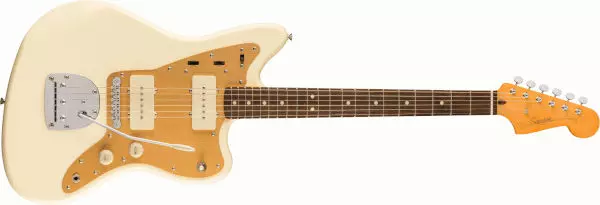
J Mascis Jazzmaster
The J Mascis Jazzmaster® features a basswood body, C-shaped maple neck, rosewood fingerboard with 9.5" radius and 21 jumbo frets, two single-coil Jazzmaster pickups with three-position switching and dual tone circuits, gold anodized aluminum pickguard, aged white plastic parts (knobs, switch tip, pickup covers), Adjusto-Matic bridge with vintage-style floating tremolo tailpiece, vintage-style tuners, chrome hardware, and J Mascis signature on the back of the large '60s-style headstock.
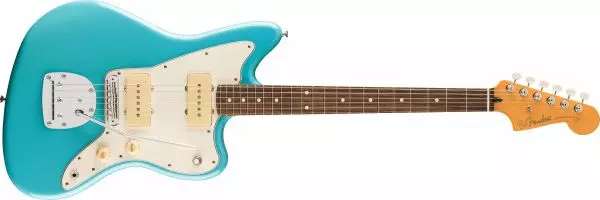
Fender Player II Jazzmaster
Everything about the Player II Jazzmaster is designed for fast and fluid playability. From the Modern "C"-profile with silky satin urethane finish on the back to the comfy 9.5"-radius slab rosewood fingerboard with smooth rolled edges and 22 medium jumbo frets. A classic alder body is available in both timeless Fender finishes and multiple colours.
Shop the Fender Player II Jazzmaster
Premium Offset Guitar Models
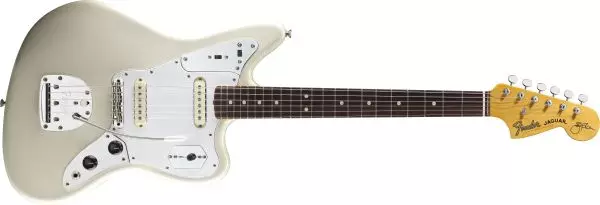
Johnny Marr Jaguar
The Johnny Marr signature Jaguar is a non-standard version of the model featuring custom-wound Bare Knuckle Johnny Marr single-coil neck and bridge pickups; custom-shaped maple neck based on Marr's 1965 Jaguar, with vintage-style truss rod, lacquer finish and Marr's signature on the front of the headstock; four-position blade-style pickup switch mounted to the lower-horn chrome plate (bridge, bridge and neck in parallel, neck, bridge and neck in series); two upper-horn slide switches (universal bright and pickup switch position four bright); Jaguar bridge with Mustang saddles, nylon bridge post inserts for improved stability, chrome cover and vintage-style floating tremolo tailpiece; and "taller" tremolo arm with arm-sleeve nylon insert to prevent arm swing.
American Professional II Jazzmaster
Fender's popular Deep "C" neck now sports smooth-rolled fingerboard edges, a "Super-Natural" satin finish, and a newly sculpted neck heel for a supremely comfortable feel and easy access to the upper register. New V-Mod II Jazzmaster single-coil pickups are more articulate than ever while delivering the sparkle and chime the Jazzmaster is known for. The bridge pickup has a tap function that allows both a powerful, throaty sound and a lower-output vintage sound. At the flip of a switch, the rhythm circuit puts both pickups in series for a thicker tone with increased output, controlled by independent volume and tone roller pots.
Shop American Professional II Jazzmaster