




The Coltrane Matrix
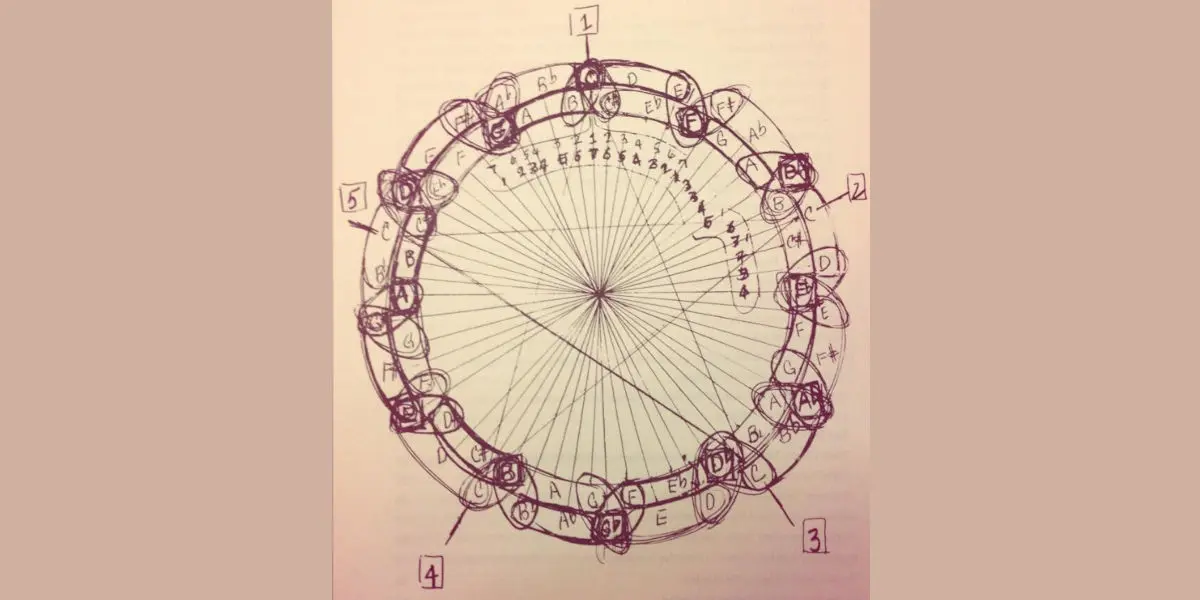
Throughout most of music history, European and Black American music used fifths in harmony. Many musicians were and are familiar with concepts such as the ii-V-I chord progression and the circle of fifths, and with how they guide us in soloing and composing.
In December of 1959, John Coltrane debuted his famous record “Giant Steps”, and with it, a completely new way of thinking about harmony. He introduced what we call the Coltrane Matrix, otherwise known as the Coltrane Changes. This is a system of harmony that connects 3 unrelated keys.
How the Matrix Functions
Many players tend to struggle to understand how the Coltrane Matrix functions harmonically, especially when soloing on a tune that features them. The main thing to understand about the Coltrane Matrix is that it moves through 3 key centers, each a major third apart.
For example, the tune “Giant Steps” moves between the keys of B major, G major, and Eb major. It becomes much easier to digest when you can chunk tunes into this frame.
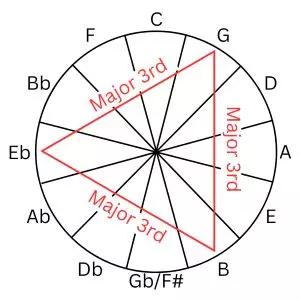
The circle of 5ths showing how the 3 keys of “Giant Steps” are equidistant from each other.
Examples of Coltrane Changes
Example 1
A lot of times in Coltrane’s compositions, he will use the different keys as a way to extend a chord progression. One of his most recognizable examples of this technique is showcased in the tune “Countdown”, where he uses it to extend a ii-V-I progression.
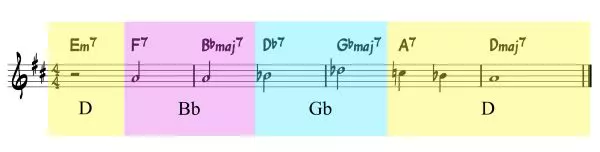
The Tune “Countdown” with the key centres highlighted
As you can see in the example above, Coltrane creates a lot more movement than if he had just used a regular ii-V-I progression. This is the most common form of the Coltrane Matrix, especially when he is reharmonizing an existing tune.
Example 2
Another great example of the Coltrane Changes is a tune before Coltrane was even playing music. The 1937 tune “Have You Met Miss Jones” by Richard Rodgers.
The B section of this tune is probably the most straightforward example of the Coltrane Changes, and I would recommend learning this tune first if you are new to the concept. Instead of using the changes to extend an existing progression, we see them used as separate key centers connected by the ii-V-I progression.
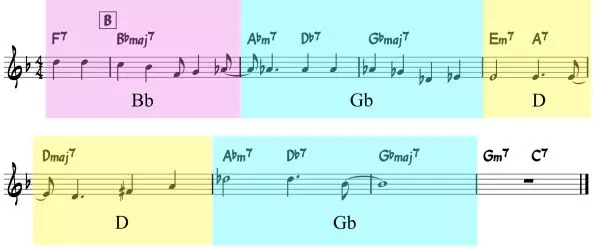
“Have you Met Miss Jones” B section with key centres highlighted
How do I Solo Over These Changes?
There are a few strategies you can apply when trying to solo over Coltrane Changes, without appearing like you’re practicing scalar exercises. A good reminder for any tune is that you don’t have to play every change, and I mean this on two different levels.
You don’t need to play every measure of the form; it’s alright if you let a few measures go by without playing anything. Space can create intrigue and allow the rhythm section to comment on what you’ve played before.
In a similar vein, you don’t need to acknowledge every single chord in a progression when you solo; it’s really only important that you show the change of key.
Looking at Common Notes
A good way to visualize this is to look at what notes are common between 2 keys.
For example, between the keys of D major and Bb major, the notes D, G, and A are all common between both keys, so you can use those notes as a bridge between both key centers, and this helps your solo sound more intentional.
Of course, another great way to learn how to solo over these changes is to listen and transcribe your favourite players who play over these tunes. This can help put some ideas you’ve had in perspective, as well as show you new ideas that you wouldn’t have thought of otherwise.
Hopefully, you now have a better understanding of the Coltrane Matrix and what makes them interesting, as well as having a few strategies for playing over the changes. Enjoy practicing!