Acoustic Guitar Tonewoods and How They Affect Sound
The year is 1692. The witch hunts are underway in the North Eastern United States, and in a dark forest not far away, an Adirondack spruce seedling barely a few inches tall has unknowingly begun its journey through time to an unpredicted fate, a destiny with beauty.
Fast forward to the present day. That strong young sapling, now a 1930s Martin acoustic immortalized through timeless recordings, peacefully rests in its case awaiting its next adventure, just as that same young tree sat in anticipation over 300 years ago.
Speaking With Tonewood Experts
As we begin our venture into this goldmine of information on the tonewoods of acoustic guitars, there are four humble industry giants we need to thank whose expertise made this article possible:
- Michael Dickenson: Dickenson has been with C.F. Martin & Co. Inc. for 35 years and is now a sourcing (wood buying) specialist, a position he’s held for 15 years.
- Mike Ausman: Ausman has been with Taylor Guitars for over 20 years and is currently their national accounts manager. He is no stranger to Long & McQuade, having visited the vast majority of all locations nationwide and been featured in several online educational videos.
- Dana Bourgeois: A master luthier, Bourgeois just celebrated the 50th anniversary of building his first guitar. He is the founder of Bourgeois Guitars, which was born 35 years ago in Lewiston, Maine (in 1991).
- Otto D’Ambrosio: D’Ambrosio is the Chief Designer at Eastman Guitars and has been building instruments professionally, full-time, for 20-plus years now.
On behalf of everyone who benefits from the knowledge contained herein, thank you, gentlemen, for your unique perspectives and for generously donating your time for the interview.
4 Pro Tips for Getting an Acoustic Guitar
Pretend you are a brand-new customer in the world of acoustic guitars with a limited budget. You visit your local Long & McQuade and realize the guitars you can afford look like real wood but are not made of “solid” wood. What does this mean? Is this a bad thing?
We often get what we pay for, but here are four pro tips to keep in mind when considering an instrument that doesn’t break the bank:
- Don't get caught up in the term “entry-level.” There are no disadvantages to purchasing the instrument that works for your situation. Whether it’s HPL (high-pressure laminate) or laminated fine veneer (thinly sliced wood glued to another material), buy an instrument that suits your needs, feels good in your hands, and speaks to you.
- Guitars that use HPL, fine veneer, and other wood alternatives are quite durable. Nobody would bring an extremely valuable solid-wood acoustic (like a Martin D-45 Modern Deluxe) on a camping trip or to an outdoor festival, but solid-wood alternatives work well for these uses. Generally, these guitars also do not react as negatively to environmental changes, such as humidity, as solid-wood guitars do.
- Comfort is king when it comes to an acoustic guitar. If playability is a concern, techs at Long & McQuade can ensure your purchase plays as well as possible. The more we want to come back to it, the more likely we are to stick with it. While the mechanics and build quality of a higher-end instrument (made with more solid wood) improve comfort, guitars are generally designed to be adjustable.
- With electronics installed, HPL/fine-veneer guitars tend to produce less feedback. Whether we’re plugging in at home or school, playing in different-sized rooms with PA equipment and multiple sound techs running boards, fine veneer with electronics tends to work great.
The best advice is to buy the highest-quality instrument you can afford. Otherwise, as specialists warn, you’ll probably end up buying two things to reach the level you should have started with. The old saying still rings true: “Buy nice or buy twice.”
The Mechanics of an Acoustic Guitar
Backing up slightly, let’s shift our focus to the instrument's mechanics to lay the foundation for why different materials and tonewood profiles matter.
An acoustic guitar’s sound is the sum of all its parts, but the majority of its sonic identity comes from its body, which is made up of two main parts: The guitar's “top” (or, soundboard) and its “back and sides.” They both have different jobs, but ultimately they function together to create our instrument's particular sound.
Broken down simply, here’s how the guitar makes music:
- The energy in our hand is transferred to the string(s) we hit
- The energy in the now vibrating string is transferred to the guitar’s bridge
- The energy in the bridge is transferred to the guitar’s soundboard (top)
- The energy in the soundboard is transferred to the air within the body
- The now vibrating air particles within the body are amplified when they’re forced to bounce off the back and sides
- Looking for an escape, the rowdy air particles are guided toward the soundhole, projecting and focusing their energy (sound) forward.
Two creative analogies we were offered by our experts to help us make sense of this were:
- Think about the body of an acoustic guitar, kind of like a human chest - it's inhaling and exhaling very rapidly to take in and remove air, while the soundboard acts like a diaphragm.
- Think of the body of the instrument like a speaker where, instead of a magnet, the strings attached to the bridge drive it, while the top acts like the speaker cone. The back and sides function somewhat like a speaker enclosure, reflecting the sound back through the sound hole. However, unlike a speaker cab, the different woods used for a guitar's back and sides naturally and intentionally colour the guitar's tone as we move from species to species.
Why does this matter? Understanding the guitar body’s mechanics is the foundation for appreciating the physical properties of different woods and how these traits contribute to the guitar's personality.
For example, knowing the top has to move, we can appreciate the elasticity and durability of the softwoods (trees that produce cones and stay green year-round) commonly used for this job. We can also admire the hardwoods (no cones and lose their leaves) often used for the back and sides, creating a structurally sound chamber to force energy back to the top.
Different Types of Resonating Material
Mike Ausman from Taylor Guitars notes that acoustically speaking, the top is the most important part of an acoustic guitar. He states that somewhere in the ballpark of 80% of what we hear is actually the top moving in some sort of fashion.
For this reason, we recommend purchasing as much natural resonating material as possible to improve projection. Mike cautions that guitars made of stacked, glued (laminated) material typically lack the purity, warmth, and projection of a solid-wood soundboard, especially without built-in electronics.
Moving on with our newly updated knowledge of the guitar's mechanics, let’s jump into the naturally resonating material that we’re really here to talk about: The most popular tonewoods used to build acoustic guitars.
Spruce
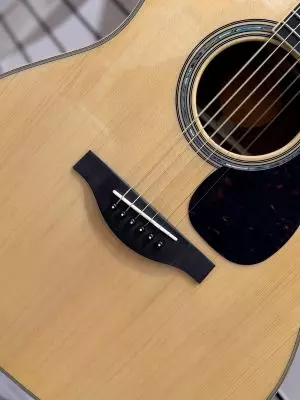
With its great tonal range and dependable consistency, spruce is without question the go-to top-wood for guitar builders. One key reason is that spruce has a high stiffness-to-weight ratio - stiffer than other softwoods.
Ever heard of a guitar being “over-built” or “under-built”? Guitar strings put around 150-200 pounds of pressure on the top and inside.
If a top is over-built, it isn't responsive to the strings' movement; it’s strong but doesn’t resonate well. If underbuilt, it gets stretched out and isn't responsive.
Between the two, there is a sweet spot guitar builders aim for, where spruce is an obvious choice. It is strong enough to hold string tension but elastic enough to vibrate.
Other Spruce Tonewoods
To make the go-to wood even more appealing, there are four main species of spruce to note: Sitka, Red, European, and Engelmann. Below, we explain the pros of each type.
Sitka Spruce:
- Best weight-to-strength ratio
- Widest tonal range (that continues to expand as the guitar gets played)
- “Swiss Army Knife” of tonewoods because it performs well with strumming chords or picking individual notes.
- Used on approximately 75% of all acoustic guitars on the planet due to their abundant availability.
- Takes about two to three years before it reaches its maximum potential
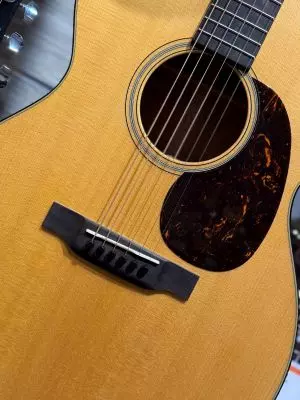
Red (Adirondack) Spruce:
- The most “explosive” top wood
- Takes generations for it to open up (pre-World War acoustics can be in the six-figure range)
- The best tonewood for bluegrass music (great projection, lots of headroom - a player can really dig in without the sound breaking up)
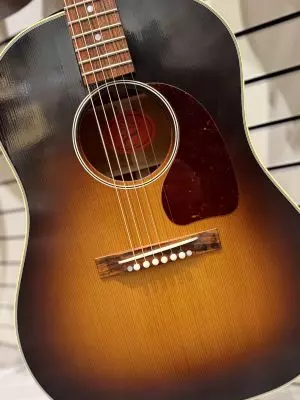
European Spruce:
- AKA: Moon, Italian, Alpine, German, European and Carpathian Spruce (same species but grows in various places)
- The lighter, airier, most responsive tops seem to grow at higher elevations.
- As you head westward, the wood tends to become denser and more bass responsive.
Engelmann Spruce:
- Has a very light colour and works well for fingerstyle
- Works well on some nylon string guitars, where players are looking for individual notes to sound out
- Popularly used in classical and flamenco music, where fingerstyle playing is most predominant
Cedar
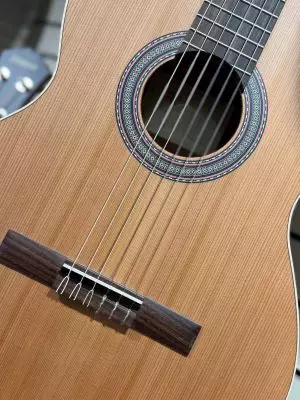
Cedar is unique. It is light, airy, and great for fingerstyle and nylon instruments. Some describe the sound of a cedar top as soft, dynamic, and requiring little energy to set in motion.
If someone is a strong strummer, they’ll overdrive it, like turning up car stereo speakers too loud. If played gently, cedar-top guitars have sparkly high-end and rumbly low end.
Unlike spruce, which tends to mature with age, some experts suggest cedar hits its prime around six months. The guitar is broken in and functioning at its highest calibre for the player right out of the gate.
Some players claim their cedar guitars lose character over time. Builders suggest this may be due to the wood's flexibility along the grain and its lightness.
While there is some truth to these observations, professionals advise against letting this deter you from including cedar-top guitars in your collection. Their sound (think later Andres Segovia) is undeniably beautiful and an extension of your “personal feel,” regardless of age.
Rosewood
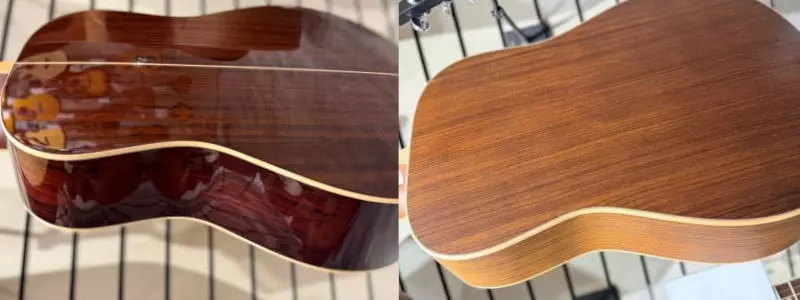
When used for “back and sides” on acoustic guitars, rosewood tends to perform best with larger instruments that desire a loud bass-driven response. Whether Brazilian, Honduran, Guatemalan, or East Indian, rosewood commonly has a bell-like, naturally reverberant sound.
In contrast to “drier” woods like maple and mahogany (which we will examine next), a player hitting a note or chord on a rosewood-heavy guitar might describe the nature of the sound as there being “something else going on, at the same time.”
Mahogany
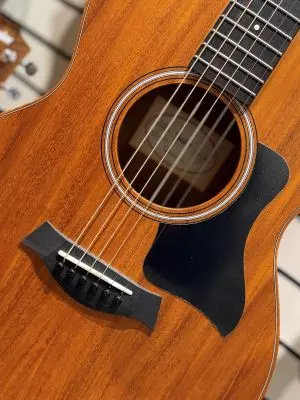
No matter which part of the acoustic body mahogany is used for, it delivers a gentle, smooth midrange blast. As one builder stated, “it's kind of like the banana of tonewood that plays and goes great with just about everything.” Mahogany’s sonic footprint has a natural bell curve in the midrange, natural woodiness, and compression.
When builders design a new bracing pattern, curves, or body shape, they often use mahogany to test it. Experienced luthiers know if it works with mahogany, it works with anything. To quote Mike Ausman, “Mahogany is the boiling water with no seasoning, or the canvas with no paint.”
Koa
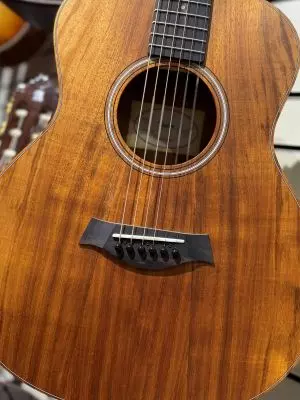
Koa can be described as Mahogany’s prettier cousin with an identical voice, a more colourful look, and a slight edge towards the trebles. Sonically, Koa is similar to Mahogany but a little more syrupy, thicker, or “richer.”
With Mahogany, you get it all at once; the overtones come very fast. With Koa, there is a bit more of a bloom.
Maple
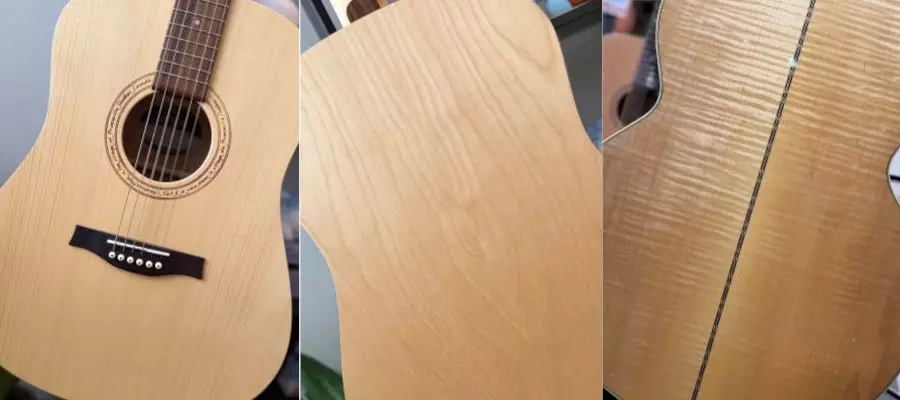
Maple’s signature is its brightness, leaning hard into the trebles. It has the ability to throw sound out of the instrument, making it very percussive and “poppy” without holding anything back.
By and large, we don't see many fingerstyle players playing maple guitars, but we see many strummers. As Dana Bourgeois observed, some guitars play chords in which individual notes don't blend, but maple guitars tend to produce a homogeneous chord sound in which notes meld.
This is apparent in many recordings where larger maple guitars are used as these big, strumming backdrops - almost like a blank canvas of sound that can be used to overlay everything else on top of. Dana points out that Keith Richards, for example, has “got a J200 buried somewhere back in the mix of more than a few Rolling Stones tracks.”
To detail the maple guitar profile, Bourgeois notes he has friends in an acoustic duo, one of whom plays a jumbo maple guitar and serves as the band's bass player, rhythm guitarist, and drummer.
As he puts it, “a regular dreadnought guitar wouldn’t be able to do that.” The Dreadnought is the most popular acoustic guitar shape with a large body well-suited to both strumming and flatpicking.
Honourable Mentions of Other Tonewoods
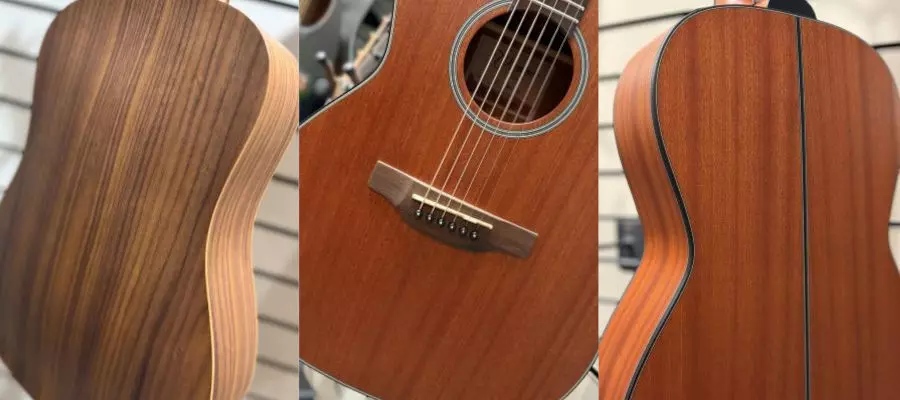
- Walnut: Sounds much like Mahogany with a slight edge towards the bassy notes.
- Sycamore: Almost referred to as Maple’s twin, supplying a bright and crisp sound.
- Sapele: Shares all the qualities of Mahogany, with an occasional striped look.
Fretboard & Bridge Material
Notably, several experienced builders expressed that the use of different woods for fretboards and bridges doesn’t necessarily affect tone in a major way, though there are preferred woods for other reasons.
Fretboard and bridge materials tend to be a matter of personal preference for builders and players. Some builders argue denser materials provide more sustain. However, the bottom line is that the wood choice for these small parts either fits the guitar’s vibe or it doesn’t.
Some popular material choices include Ebony (which comes standard on about 95% of Taylor guitars), Richlite™, Katalox, Granadillo, Indian Rosewood, Madagascar Rosewood (slightly preferred by some over Brazilian for how it wears), Pau Faro, Maple, and Ziricote.
A higher-quality instrument demands higher-quality parts. There can be a large variety in two fingerboards made from the same species, which is why selection is important. The best cuts are dense enough to hold frets well and striking enough to showcase inlay work (with sufficient contrast).
Multi-Piece Neck Construction
Experts Otto D'Ambrosio and Dana Bourgeois agree that multi-piece neck construction has a negligible effect on an acoustic guitar's tone. Bourgeois notes that design, top wood, back-and-side selection, and overall construction account for most of a guitar's sound, with only a small percentage influenced by details like a three-piece versus a one-piece neck.
The Effect of Tonewood Age
Tonally, we have hopefully already established that the type of tree influences tone, but there are other important factors that affect these woods' innate sound, which most of us often overlook.
These factors have less to do with the species of tree and more to do with their age and environment. Unlike any man-made instrument material, there are several variables throughout a tree's growth that must go right in order for it to be a candidate for higher-end guitar construction.
Age
While that new acoustic of ours might have only been sitting in our living room for a few months, its presence should demand a higher amount of reverence than how we’d treat a new set of kitchen chairs. Especially if it’s a higher-end guitar, we must respect that for a tree to have been of this calibre, it typically would’ve had to have been between eighty and 300 years old.
More specifically, hardwoods tend to be at the lower end of this range, while softwoods lean toward the higher end. The most popular soundboard material, spruce, sits right in the middle, averaging about 150 years old, and is wide enough to make higher-end guitars.
Age will, of course, vary, and the wood must also dry for a period after being harvested - but still, the bottom line here is that this once living thing in our hands has been on earth longer than we have, and this should yield appreciation.
Environment
As previously discussed, the age of a tree is important - but arguably even more influential on a tree's suitability for use on a higher-end instrument is its upbringing: the climate and the environment in which that tree grew.
Irregularities in a tree's environment will cause irregularities in wood density, which substantially affect a tree's usefulness as a tonewood.
Trees grow at different speeds. Naturally, a tree in a temperate forest (which experiences all four seasons) tends to grow faster, but if the forest is dense, that growth rate slows.
Tree Growth Rings
Even more paramount is how consistent the environment is - the same amount of rain, the same amount of sun and the same amount of wind year after year will lead to what luthiers refer to as uniform tight grain. Grain, being simply the line patterns you see on the wood, the circular rings of the tree, each representing a year of its life.
Tree growth rings provide insight into how the tree developed:
- Tighter growth rings normally indicate slower, more consistent growth and are frequently preferred for instrument tops.
- Very wide growth rings suggest abundant water, rapid growth and are usually considered less desirable.
- While ring spacing matters, specialists emphasize that extremely tight grain is not necessarily required; moderate, uniform spacing is often ideal.
- A somewhat commonly cited benchmark is around twenty grain lines per inch, though acceptable variation exists, of course.
- Trees often do not grow perfectly straight; they actually twist left or right. This naturally occurring process can create what’s called runout, which, in excess, can negatively affect both the appearance and structural characteristics of a guitar top.
Earlywood vs. Latewood
Each annual growth ring contains summer growth (earlywood) and winter growth (latewood). Earlywood is a lighter-coloured, softer wood, while the winter latewood is darker, denser, and structurally stronger.
The darker winter growth acts as the tree's structural framework, similar to joists supporting a floor. And the ratio of dense latewood to softer earlywood considerably affects the soundboard's stiffness and stability.
Wood Choices For Live Performers, Singers & Songwriters
When selecting an acoustic guitar for accompanying vocals, tonewood choice can influence how the guitar sits alongside the singer's voice, though playing style is equally important. We will unpack the following gradually, but the three key questions when choosing a guitar are:
- Do you sing?
- How many people do you play with?
- What do you use to attack the strings (fingers, pick, etc.)?
The two main perspectives from the experts interviewed seemed to favour either rosewood or mahogany. One perspective strongly favoured mahogany back and sides with a Sitka spruce top, arguing that this combination works especially well with the human voice.
However, another viewpoint suggested that rosewood can actually be ideal for solo singer-songwriters because of its EQ profile:
- Strong bass response
- Clear, pronounced treble
- Slightly recessed midrange
Since the human voice primarily occupies the midrange frequencies, a rosewood guitar leaves more sonic space for vocals, helping them stand out. A useful rule of thumb offered by Michael Ausman was: “The fewer people you play with, the more rosewood you want." For a solo performer or singer-songwriter, Rosewood's scooped-midrange character can complement vocals effectively.
In contrast, because human voices also occupy the midrange, mahogany and vocals can share similar frequency space. This is able to create a cohesive, blended sound, particularly in:
- Duets
- Small ensembles
- Fingerstyle playing
- Ragtime
- Latin music
- Jazz
- Slide blues
If we’re talking about larger groups, however, we must give more consideration to the fact that every instrument competes for a limited "sonic slice." Tonewoods that occupy different frequency ranges can help instruments coexist more clearly in a mix.
On this note, we really cannot conclude that there is a universal best choice of tonewood for singers. A fingerstyle singer-songwriter may prefer one type of guitar. A heavy strummer may need something completely different. Playing technique and musical style can matter as much as the wood itself.
James Taylor, for example, is cited as a player whose piano-like accompaniment style works well with a cedar-top guitar (with Rosewood back and sides) - not the most popular combination you’ll see hanging up on the walls of your local music store.
Conclusively, the best choice depends on our style, vocal range, ensemble size, and how we want the guitar and voice to interact in the mix.
Wood Choices for Studio Recording
For studio recording, our specialists' most popular recommendation was mahogany back and sides with a Sitka spruce top, because mahogany's tonal characteristics are often easier to record and mix than those of more complex tonewoods.
Several reasons are given for mahogany's popularity in the studio:
- Mahogany has a simpler harmonic and overtone structure than rosewood.
- Recording engineers can more easily capture the complete sound.
- Its strong midrange focus provides a clear, balanced signal that sits well in a mix.
- Engineers can easily add bass, treble, or other EQ adjustments later, whereas removing unwanted frequencies is often more difficult.
Yes, mahogany and Sitka spruce are often favoured for studio recording. However, professional session musicians benefit from owning multiple guitars, a few of which may include:
- Maple, with its brightness and clarity (commonly complementing female vocals)
- Koa provides an evolving, tonally unique personality.
- Other specialized combinations, such as Engelmann/koa, serve fingerstyle players particularly well.
To summarize, different musical situations require different tonal characteristics, and just as a painter uses multiple colours, a session player benefits from an arsenal of instruments.
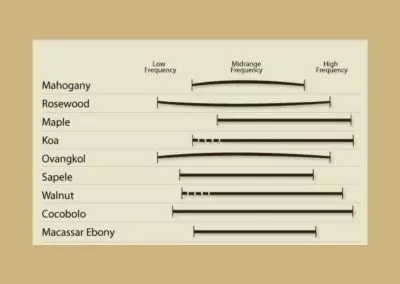
Ausman's Tone Chart
Concluding Tonewoods
After speaking with a few of the industry's most respected specialists, one thing becomes clear: there is no single "best" tonewood.
Each species brings its own strengths, personalities, and musical applications. While material choice undoubtedly influences an acoustic guitar's voice, it is only one piece of a much larger equation that includes design, craftsmanship, age, construction techniques, and, perhaps most importantly, us - the players.
Whether we're purchasing your first acoustic guitar from Long & McQuade or adding another instrument to a growing professional collection, understanding tonewoods can help guide our decision - but our ears should always have the final say.
After all, most great guitars begin as a tree, but they become instruments only when we bring them to life through music.